
One delicate specimen turns an almost empty page into something worth getting close to.
The blue catches you first. Then the fine pale branches begin to appear, spreading upward from a small tangled base. There is a surprising amount happening in this little patch of apparent emptiness. Get closer.
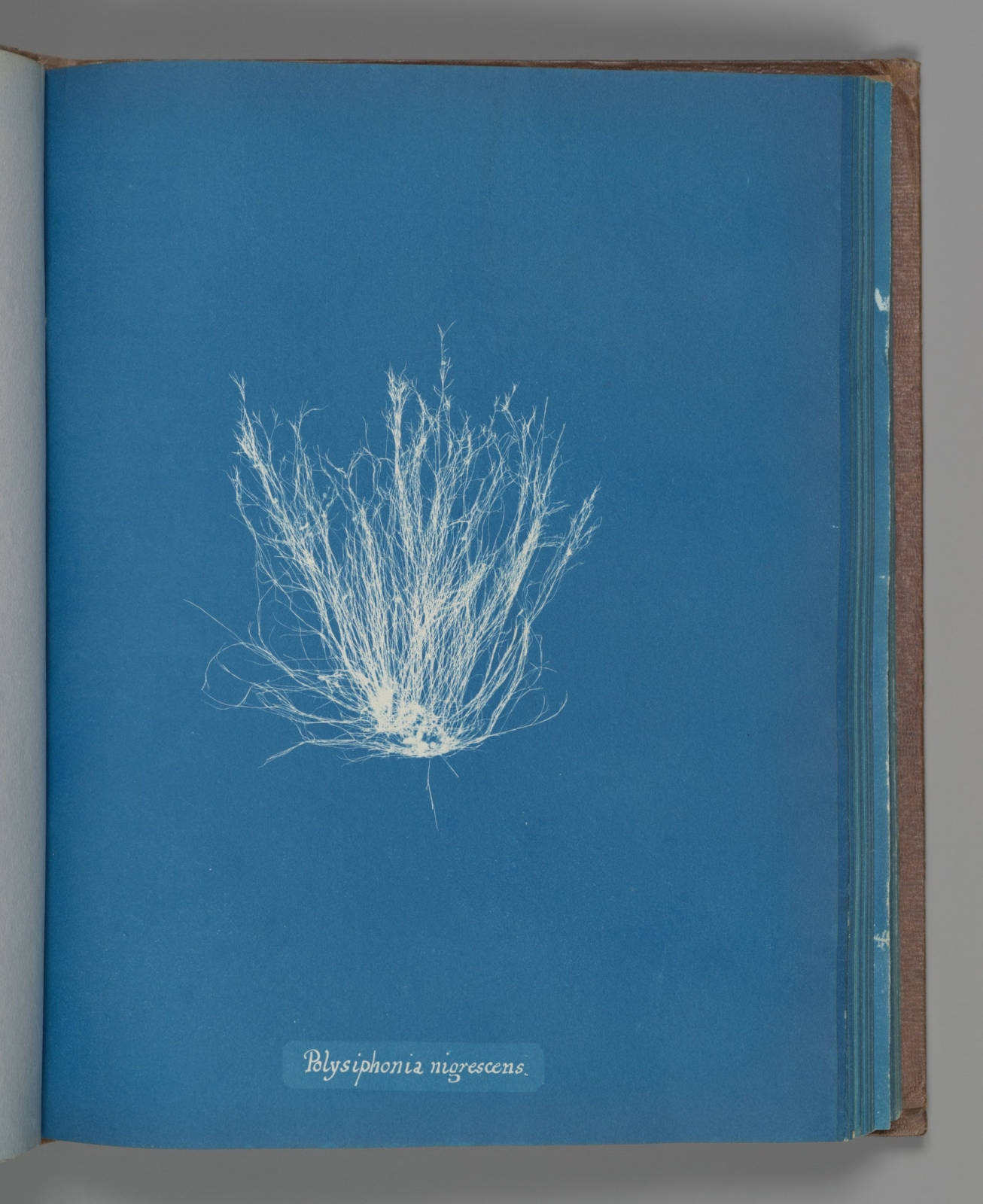
Anna Atkins made this cyanotype, Polysiphonia nigrescens, around 1853. The Metropolitan Museum of Art places it in its photography collection. The name appears beneath the specimen in delicate handwriting, giving the page a second kind of line to follow.
The specimen sits low in the image, leaving a generous stretch of blue overhead. Its branches reach toward that space without filling it. Near the bottom they overlap densely; higher up, individual threads separate until some are barely visible. The contrast gives your eye a reason to keep adjusting.
There is a pleasing change of pace between looking at the whole page and trying to trace one strand. From a distance, the shape holds together like a little plume. Close up, that tidy impression dissolves into intersections, fine tips and uneven edges.
The handwritten label makes this feel like a page someone wanted you to return to. You can read the name and move on, or stay with all those small differences in the branching form. That second option is where the picture gets especially rewarding. A blue field, a pale specimen and enough detail to slow the scroll.
View the museum collection record.
Polysiphonia nigrescens, ca. 1853. Anna Atkins. The Metropolitan Museum of Art, Gilman Collection, Purchase, The Horace W. Goldsmith Foundation Gift, through Joyce and Robert Menschel, 2005. Accession 2005.100.557 (46). Image: The Metropolitan Museum of Art, Open Access, Public Domain / CC0.
Thank you for reading independent culture. Join the discussion below.
Talk with Leah & Chetuno
We read contributions personally. New comments are reviewed before publication; a response may take a little time.