
A dream can be a comfortable thing when it lives somewhere in the future. There is room to imagine the breakthrough, the good review, the moment when all that effort finally makes sense. Bringing it into your everyday life means making room for the disappointments, too.
That is where Cade Hoppe begins when we ask about Safer at a Distance, his album announced for November 13. In written answers to Bubbling Box, he explains that the title comes from the opening line of “Make Me King.” The relationship at the center of that song reaches beyond romance: he was personifying music itself, and the dream he has chosen to pursue.
“When a dream like that is put on the back burner well out of reach, you can still romanticize it; when you’re constantly chasing and reaching for it, it can be much more painful.”
It is an unusually candid place to start a conversation about a record. We are used to hearing the inspirational version of this story, where commitment supplies its own happy ending. Hoppe leaves room for the days when commitment hurts.
Acceptance, denial and the stories we keep
When we ask whether the album’s structure was designed around a movement between acceptance and denial, Hoppe makes a useful distinction. He recognized the recurring theme once the album had come together. It reflected what he was feeling while writing the songs, rather than a sequence he had mapped out in advance.
“If anything it’s a reflection on the main feelings I was having as I wrote a lot of these songs in this period of my life—acceptance and denial in the face of uncertainty.”
“Flatearther,” the single currently highlighted on his official website, gives us another way into that conversation. Our question concerns the vulnerability of someone who wants to believe something despite the evidence. Hoppe’s answer turns toward the people around them: a person can construct a reality they want to inhabit, but others have to decide whether to share it.
“The real question is whether or not people will want to live in that world with you.”
That question reaches beyond a song’s narrator. How much of a dream depends on someone else agreeing to see it? What happens when they don’t? Those are questions readers can bring to the album without needing a music career of their own.
What the voices can carry
Hoppe is equally careful when we suggest that a production decision might have changed the meaning of a lyric. He doesn’t accept the premise simply because we have asked it. Instead, he points to what an arrangement can add emotionally.
His examples are the bridges in “Lake Michigan” and “Give It Back.” He describes their stacks of vocals as adding layers of feeling: desperation can become more apparent while sadness is partly disguised. For him, these passages are the emotional peaks of the two songs.
It gives us something specific to listen for in those tracks: the relationship between the words and the voices carrying them. A lyric can stay in place while the arrangement changes how much of its feeling reaches the surface.
Showing up without a scoreboard
We also ask what he brought from finance studies, college basketball and service work into music. The useful habit is straightforward: showing up and doing the work, including when inspiration is absent.
The habit he has had to question is comparison. In a basketball game or an exam, the results can arrive quickly and look objective. Music gives him a less definite way to judge himself against someone else.
“I learned the discipline of showing up and doing the work, which can be especially hard in music where you don’t always have the creative inspiration.”
There is no tidy solution tucked into that answer. A routine can help you keep making things; it cannot guarantee what the world will make of them. Hoppe’s account leaves both parts in view. For anyone who has tried to turn something they love into the work of their life, that uncertainty may feel very familiar.
Making room for his own songs
The move from New York to Los Angeles brought a practical change: Hoppe became a full-time producer. Working on other artists’ projects now takes much of his creative bandwidth, so writing for himself requires a deliberate place in the schedule.
He also describes Los Angeles as a place that has opened new creative possibilities. Being surrounded by artists pursuing their ambitions and consuming more art has given him more stories to draw on, even as his time to write has become harder to protect.
Asked what advice comes more easily than following it, he points to a challenge that connects back to the album’s uncertain pursuit: “submit yourself to rejection without fear.” He is clear that this remains easier to say than to do.
For listeners arriving through this album, Hoppe suggests working backward to his previous EP, Just Look at the Moon, then his earlier EPs. It is how he approaches discovering other artists, too: follow the work back and hear how it developed. He expects songs from that EP and the new album to remain part of his live sets.
Safer at a Distance was announced for November 13. Visit Cade Hoppe’s official website for the current single and release updates.
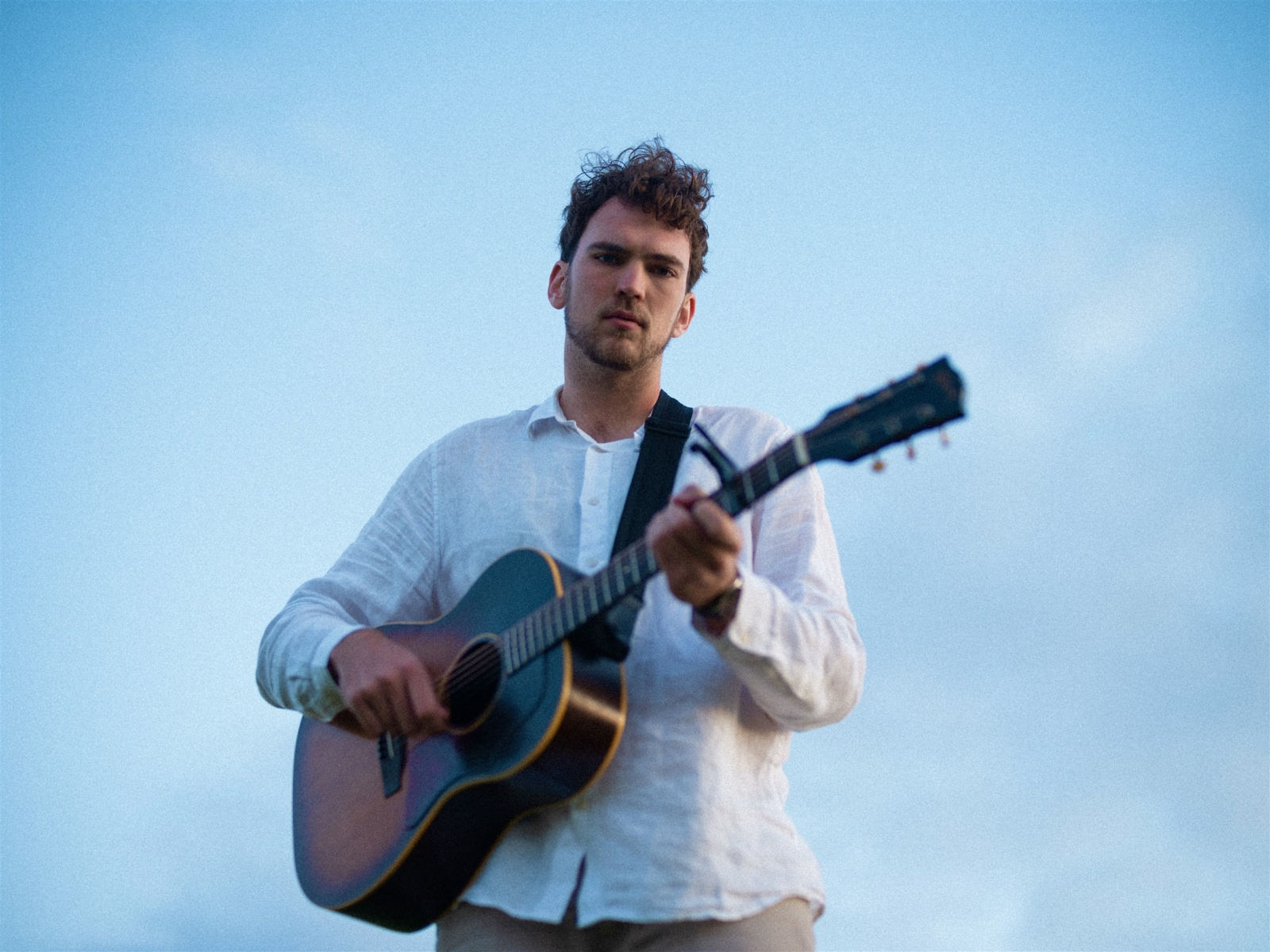
Photo: EUDA. Official press photograph supplied by Tallulah PR + MGMT; used with editorial permission.
Thank you for reading independent culture. Join the discussion below.
Talk with Leah & Chetuno
We read contributions personally. New comments are reviewed before publication; a response may take a little time.