
Have you ever stopped to read the label inside your favorite piece of clothing? Chances are, somewhere in your closet you’ll find nylon, polyester or a blend of natural and man-made fibers. But there was a time when clothing depended almost entirely on what nature provided.
Cotton, linen, wool and silk dressed generations for centuries. Then scientists began asking whether fibers could be manufactured rather than grown or harvested. Their discoveries changed not only how clothes were made, but how we wore and cared for them.
The beginning of man-made fibers
In the late nineteenth century, French chemist Hilaire de Chardonnet developed an artificial silk that entered commercial production in France in 1891. An early form of rayon, it offered an alternative to natural silk. Rayon is technically a regenerated cellulose fiber, rather than a fully synthetic one, because its raw material comes from natural sources such as wood pulp.
Nylon changes everything
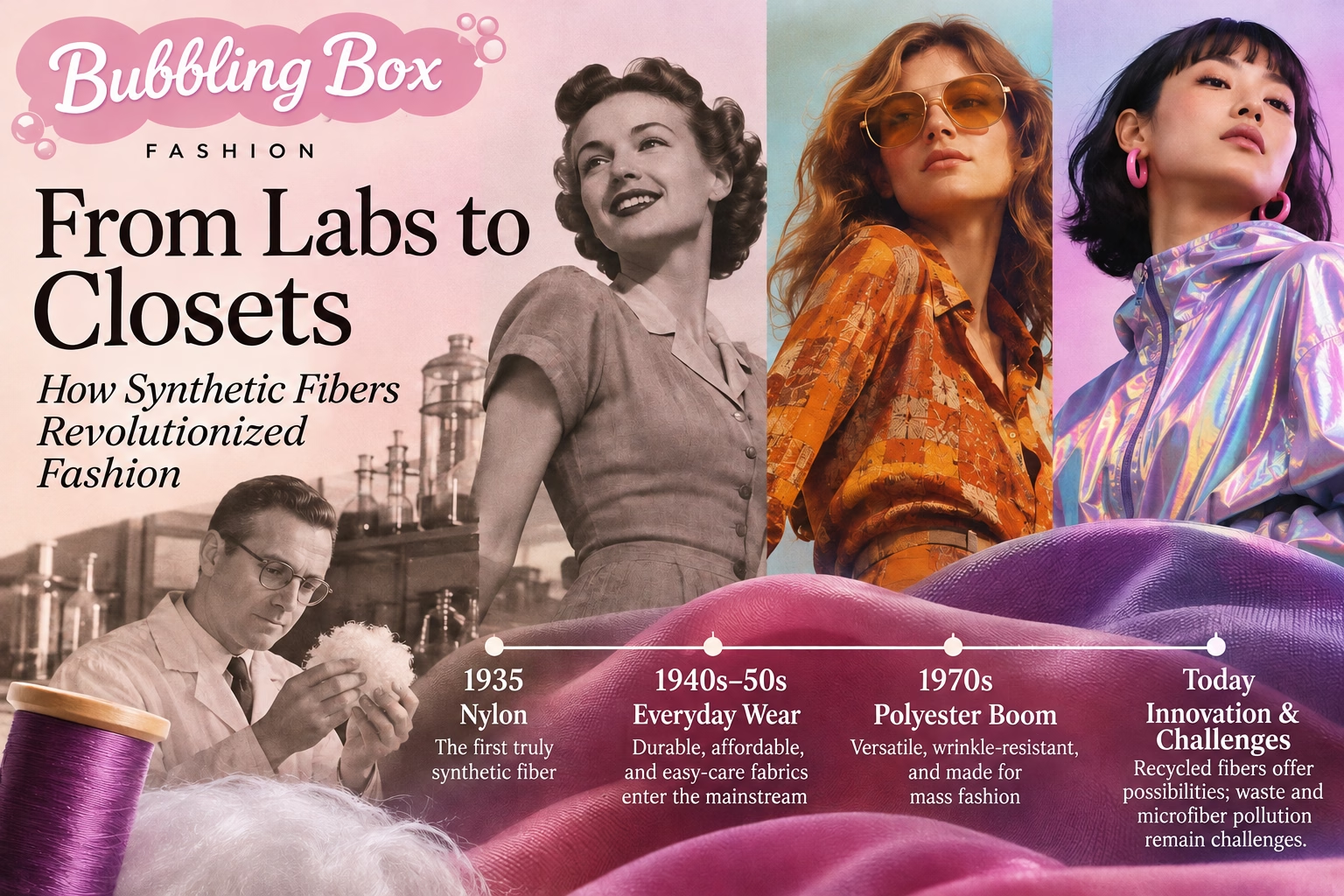
In 1935, in Wilmington, Delaware, a research team led by Wallace Carothers at DuPont developed nylon, the first commercially successful fully synthetic textile fiber. Nylon stockings were showcased at the 1939 New York World’s Fair and went on sale nationwide in May 1940. Their strength and silk-like appearance made them an immediate sensation.
During World War II, nylon was redirected toward military applications, including parachutes. After the war, it returned to civilian wardrobes, opening up new possibilities for hosiery, lingerie and everyday clothing.
The rise of polyester
In 1941, British chemists John Rex Whinfield and James Tennant Dickson, working for the Calico Printers’ Association in England, developed the polyester fiber known as Terylene. Polyester later became widely available in the United States under brands such as Dacron. Its durability, wrinkle resistance and easy-care properties helped transform everyday clothing during the 1950s and 1960s. By the 1970s, polyester was practically a household name.
From the laboratory to the runway
Synthetic fabrics weren’t confined to inexpensive everyday clothing. Cristóbal Balenciaga experimented with nylon raincoats as early as 1947, and Paris couture designers embraced manufactured fibers in the 1950s. In the 1960s, Pierre Cardin and André Courrèges used modern materials to create futuristic fashions inspired by the Space Age. There is no clearly established single first designer to embrace all synthetic fibers, but these designers helped demonstrate their creative potential.
What it means for our closets today
Synthetic fibers made it possible to create lightweight outerwear, stretchy athletic clothing, quick-drying garments and fabrics that require less ironing. Blending manufactured fibers with cotton or wool also gives designers more control over texture, fit and performance.
Today, the industry is exploring recycled fibers and improved manufacturing methods as it confronts challenges such as plastic waste and microfiber pollution. Natural fibers remain important, too; the revolution expanded our choices rather than replacing nature entirely.
The next time you slip into your favorite stretchy jeans, pull on a lightweight jacket or pack a dress that doesn’t need ironing, consider the decades of scientific innovation that helped make those conveniences possible. Fashion isn’t just about what we wear — it’s also about the ingenuity behind what we wear!
Sources
- Smithsonian: Chardonnet silk
- American Chemical Society: Wallace Carothers and the Development of Nylon
- Science History Institute: Nylon: From Labs to Legs
- Polyester: A Cultural History
- Hagley Museum and Library: Nylon and high fashion
- V&A: An introduction to 1960s fashion
Thank you for reading independent culture. Join the discussion below.
Talk with Leah & Chetuno
We read contributions personally. New comments are reviewed before publication; a response may take a little time.