
A small nineteenth-century accessory gives the eye a very busy night out.
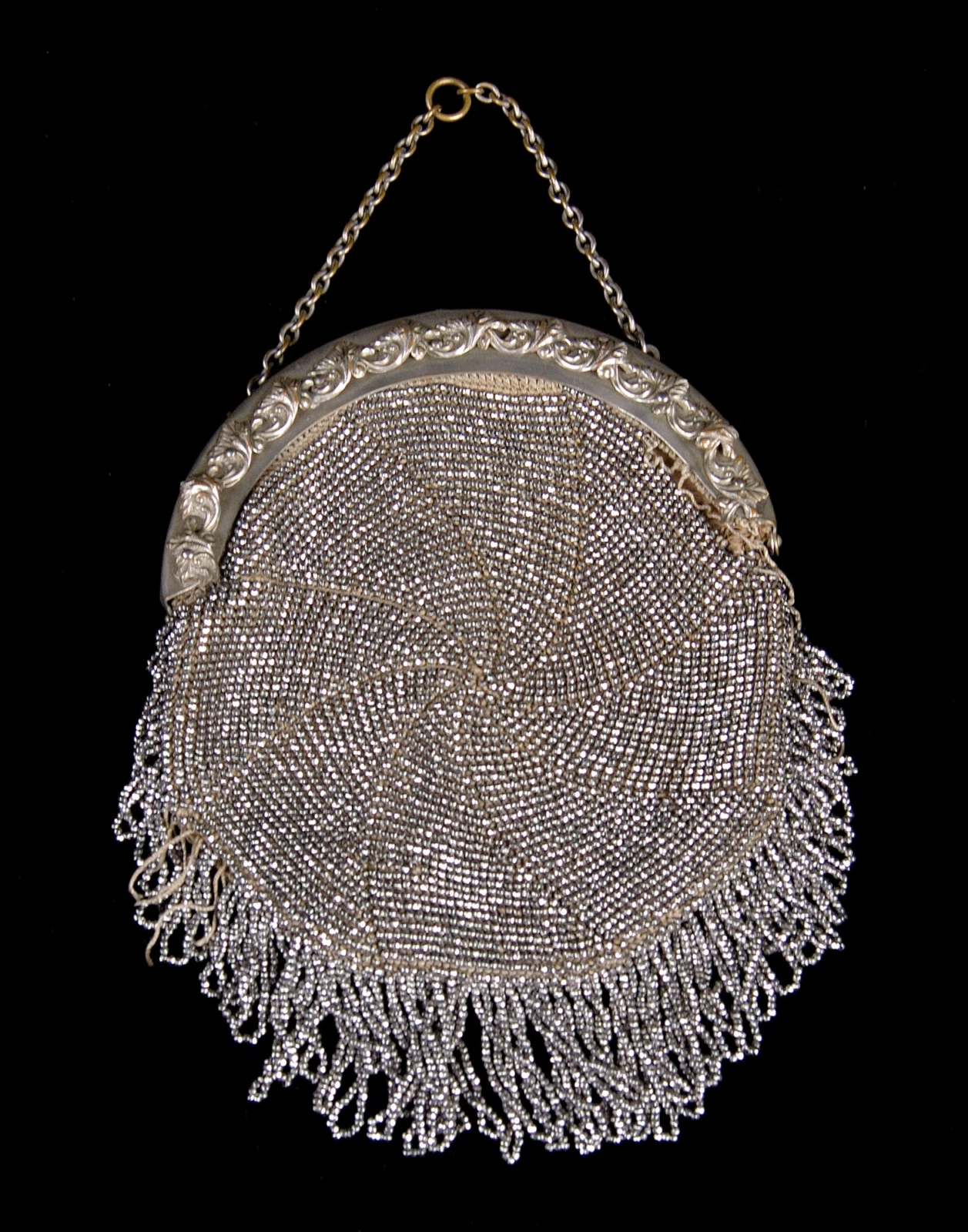
This bag has fringe, a decorated frame and a chain handle. It seems unlikely to disappear quietly into an outfit. In the museum photograph, tiny bright points collect across its rounded body, while loops along the bottom give the outline a lively finish.
The Metropolitan Museum of Art dates the evening bag to 1850–59, describes its origin as probably European and lists its materials as metal and cotton. No maker is named in the collection record. The photograph gives us plenty to enjoy without turning that uncertainty into an invented designer story.
Start at the top. The short handle makes a triangle above the curved frame, where scrolling decoration introduces a much bigger pattern than the closely packed detail below. Your eye moves from one scale to another before it has even reached the fringe.
At the bottom, those repeated loops soften the edge. Across the body, the pattern bends with the rounded shape instead of reading like a flat panel. The photograph makes a particularly good case for looking at an accessory from the outside in: silhouette first, surface second, little finishing details last.
Would it suit a plain outfit? Visually, that would give all this detail plenty of room. But the pleasure here does not depend on rebuilding an entire nineteenth-century wardrobe. One small object can supply a generous amount of sparkle, texture and movement. This one certainly earns its close-up.
View the museum collection record.
Evening bag, 1850–59. Maker not identified. The Metropolitan Museum of Art, Brooklyn Museum Costume Collection at The Metropolitan Museum of Art, Gift of the Brooklyn Museum, 2009; Anonymous gift, 1944. Accession 2009.300.4409. Image: The Metropolitan Museum of Art, Open Access, Public Domain / CC0.
Thank you for reading independent culture. Join the discussion below.
Talk with Leah & Chetuno
We read contributions personally. New comments are reviewed before publication; a response may take a little time.