
Turner’s Venice: Follow the Light Across the Water
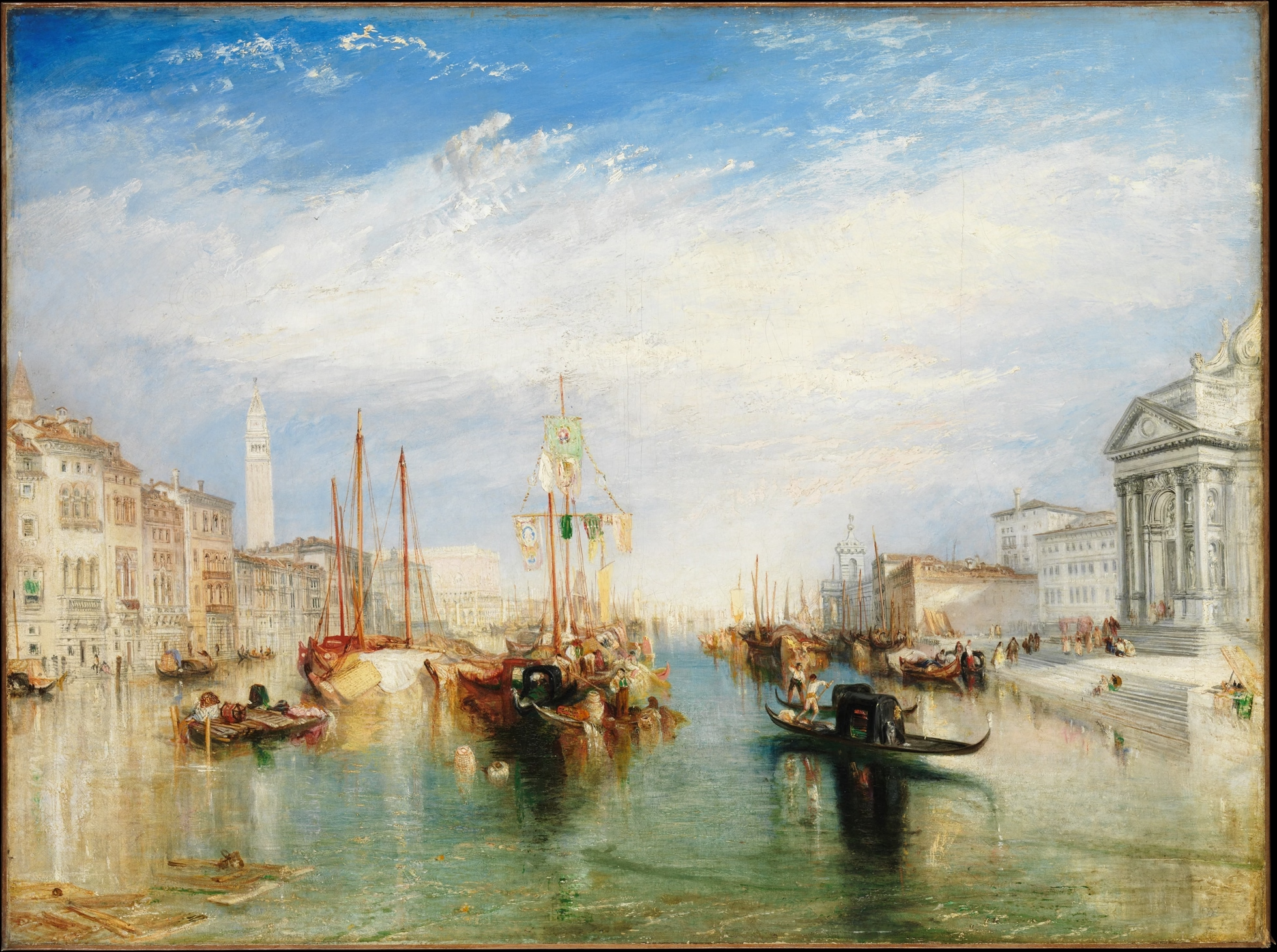
Boats, pale palaces and reflections that make the city seem to loosen at the waterline.
The water is a very good place to begin. Pale reflections stretch down from the buildings, boats interrupt the surface, and a patch of light seems to pull the whole view open. Turner gives the eye somewhere to travel.
Joseph Mallord William Turner painted Venice, from the Porch of Madonna della Salute around 1835. The oil painting is in The Metropolitan Museum of Art, whose account connects the composition to an 1819 drawing and the artist’s later return to Venice in 1833. It was exhibited at London’s Royal Academy in 1835.
In the image, the buildings along the left establish a long edge. Follow it into the distance and the architecture becomes smaller, paler and less insistent. Nearer the foreground, masts and boats interrupt that recession. Your attention can move outward toward the city, then come back to something close enough to inspect.
Above it all is a broad stretch of sky. Blue appears between cloud shapes, while the lighter areas echo the brightness on the water. The painting leaves a lot of room for those two expanses to answer each other.
Try looking at the meeting point between a palace and its reflection. The building has a more definite shape above the canal; below, the same colors break into softer marks. That change is one of the pleasures of this view. Solid architecture gets a second, less settled version of itself.
There are several easy ways into a painting like this. Follow a mast upward. Look for the warmest patch of color. Trace a reflection until it stops being recognizable as a building. Each route lets a different part of the picture take the lead.
Come back to the water at the end. By then, it may be holding far more of the city than you noticed at first.
Explore the object: Venice, from the Porch of Madonna della Salute at The Metropolitan Museum of Art.
Venice, from the Porch of Madonna della Salute, ca. 1835. Artist: Joseph Mallord William Turner. The Metropolitan Museum of Art, Bequest of Cornelius Vanderbilt, 1899. Accession 99.31. Image: The Metropolitan Museum of Art, Open Access, Public Domain / CC0. Collection record. Image use terms.