
Utamaro Makes One Letter Fill the Room
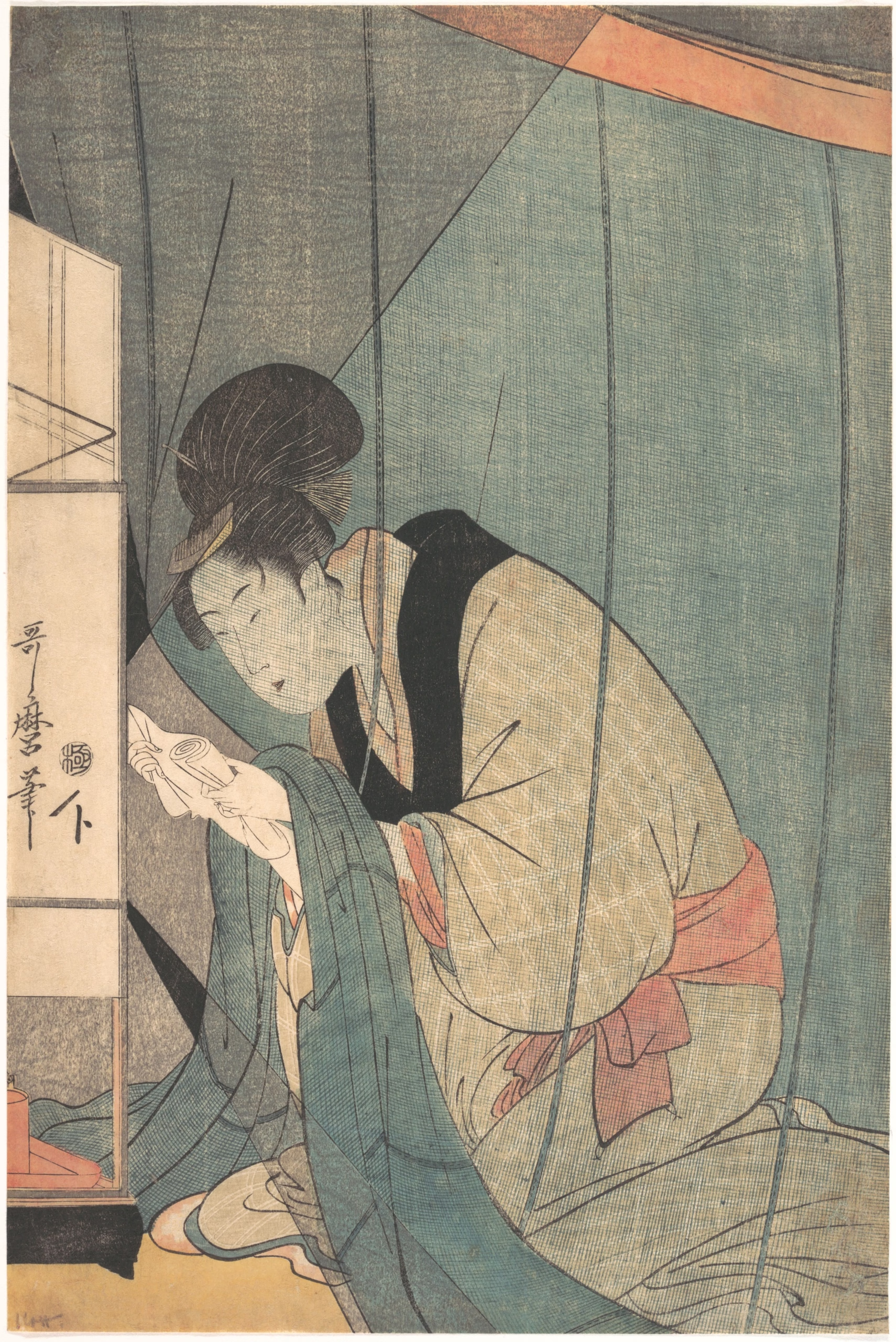
A quiet woodblock print with the concentration turned all the way up.
Whatever is in that letter, it has her full attention. A woman bends toward the paper, her hands drawn close to her face. Around her, the green mosquito net hangs across the scene. The room feels hushed, but the picture is far from still.
Kitagawa Utamaro made Woman Reading a Letter under a Mosquito Net around 1798. The Metropolitan Museum of Art identifies it as a Japanese woodblock print in ink and color on paper. Its subject is wonderfully specific: one person, one message and the effort of reading it.
The museum points to the lantern’s triangular spread of light and the woman’s movement toward it. Look at the long diagonal above her, then at her tilted head and the small pale shape of the letter. Those angles pull your attention into the same little area that has captured hers.
The net is the detail worth lingering over. Its green runs across the figure and the space around her, making a boundary you can see through. Clothing, hands, face and paper remain distinct, yet everything belongs to this enclosed moment.
There is no need to invent the contents of the message. A declaration? Household news? The print leaves us outside that conversation. What it gives us is the posture of someone absorbed in it. Utamaro makes that enough to keep us looking.
Explore the object: Utamaro Makes One Letter Fill the Room — The Metropolitan Museum of Art collection record.
Woman Reading a Letter under a Mosquito Net, ca. 1798. Kitagawa Utamaro. The Metropolitan Museum of Art, H. O. Havemeyer Collection, Bequest of Mrs. H. O. Havemeyer, 1929. Accession JP1659. Image: The Metropolitan Museum of Art, Open Access, Public Domain / CC0. Collection record. Image use terms.
